In industrial material handling, the efficiency of bulk packaging operations depends heavily on how well the packaging system matches the material and filling equipment. Among the components that deserve more attention is the filling spout of a Flexible Intermediate Bulk Container (FIBC), commonly known as a ton bag or bulk bag. When shape retention and space optimization are required, specialized designs like the Form Stable Baffle FIBC Bulk Bag are often employed.
The bag body determines payload capacity, strength, and overall durability, while the filling spout directly affects material flow, filling speed, dust control, and compatibility with automated equipment. A spout that is too small can restrict material flow and cause bridging, while an oversized spout may create sealing problems, uncontrolled discharge, or excessive dust.
For facilities handling powders, granules, minerals, chemicals, food ingredients, or other bulk materials, selecting custom FIBC bulk bag filling spouts based on actual operating conditions can significantly improve filling consistency and reduce interruptions on the production line.
The Physics of Material Flow and Spout Dimensional Mapping
The correct filling spout specification starts with the material itself. Bulk density, particle size, moisture content, flowability, and angle of repose all influence how efficiently a product moves through the filling opening.
Fine powders such as cement, flour, pigments, and chemical powders may have relatively poor flowability. If the spout diameter is too narrow, particles can compact or interlock above the opening, creating bridging and interrupting the filling process.
Granular materials generally flow more freely, but their characteristics still vary considerably. Plastic pellets, fertilizer granules, sugar, and mineral granules may require different spout dimensions depending on particle size and bulk density.
Spout diameter should therefore be matched with the filling equipment's target flow rate rather than selected simply according to the nominal bag capacity. The cross-sectional area of the opening determines how much material can pass through at a given velocity, while the filling machine controls the overall delivery rate.
Spout length is equally important. The spout must be long enough to engage securely with the filling machine's clamp or fill tube while leaving sufficient material for tying or sealing after filling. In practical applications, many procurement teams specify additional length beyond the machine's clamping area to prevent excessive tension on the woven fabric.
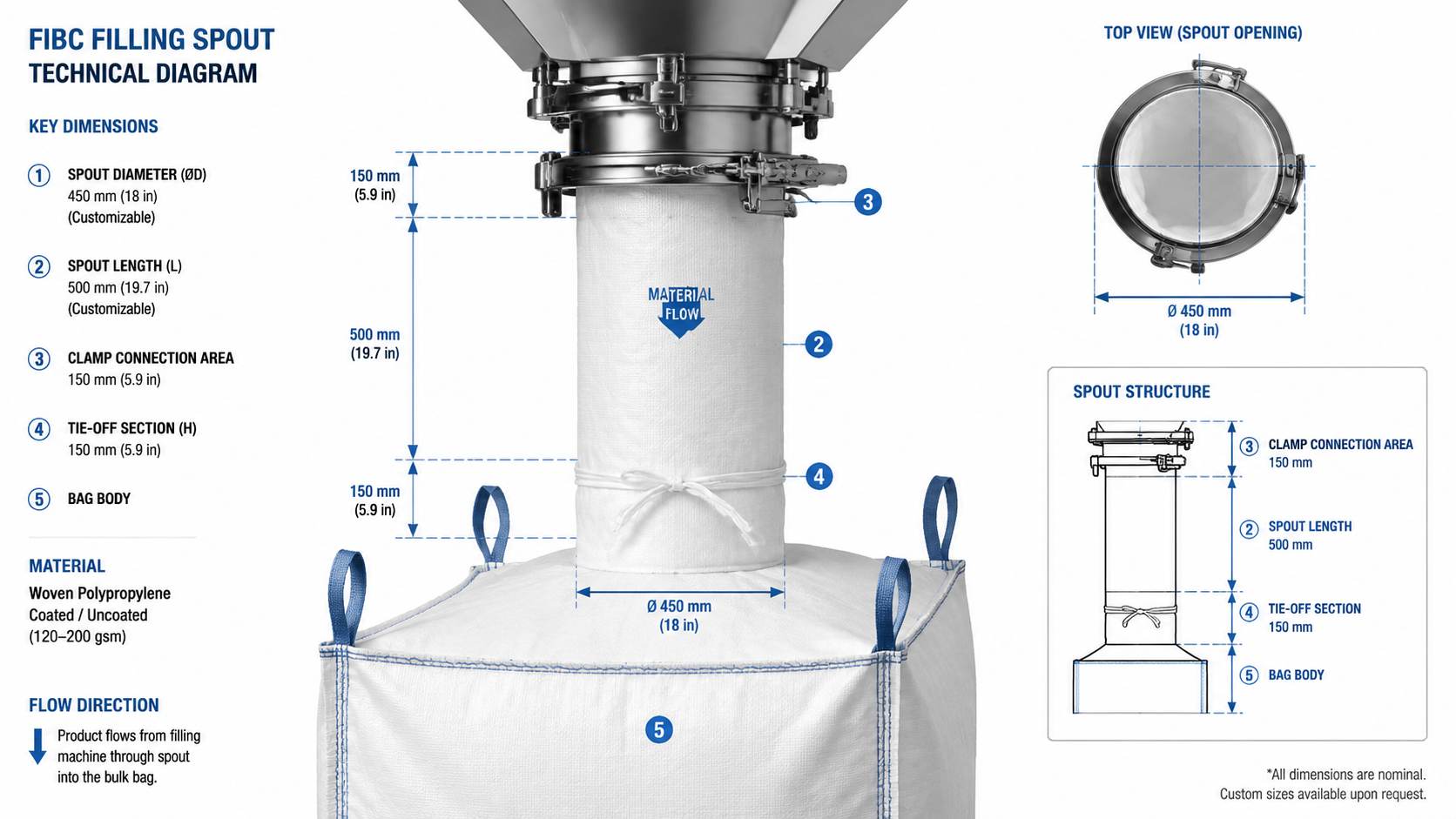
Key Specifications Procurement Teams Should Confirm
Before ordering FIBC bags for a new filling line, purchasing and engineering teams should document several dimensions rather than specifying only "standard filling spout."
| Specification |
Why It Matters |
Typical Consideration |
| Spout Diameter |
Determines material flow capacity |
Match with filling equipment |
| Spout Length |
Affects clamping and closure |
Allow sufficient tying length |
| Fabric GSM |
Influences strength and flexibility |
Higher for demanding applications |
| Coating |
Affects dust and air permeability |
Coated or uncoated according to process |
| Tie-Off Method |
Prevents leakage after filling |
Cord, web tie, B-lock, or closure |
| Spout Construction |
Influences durability |
Single or reinforced construction |
| Inner/Outer Tube Compatibility |
Critical for automated filling |
Match machine dimensions |
| Material Compatibility |
Prevents contamination or degradation |
PP, coated PP, or specialized fabric |
A standardized specification sheet can prevent repeated trial-and-error during procurement and make it easier to reorder bags from different production batches.
Comparative Analysis of Material Types
Different materials require different combinations of spout diameter, strength, and dust-control characteristics.
| Material Classification |
Bulk Density (kg/m³) |
Typical Spout Diameter (cm) |
Flow Consideration |
Primary Challenge |
| Fine Powders |
500–800 |
30–35 |
Moderate |
Dust and bridging |
| Granules |
800–1,200 |
35–40 |
High |
Static and flow control |
| Aggregates |
1,500–2,000 |
45–50 |
High |
Abrasion and impact |
| Cohesive Powders |
600–900 |
40–50+ |
Low to moderate |
Bridging and compaction |
These figures should be treated as engineering reference ranges rather than universal specifications. Actual requirements should be verified through material testing and the filling machine manufacturer's recommendations.
Integration with Facility Machinery and Clamping Systems
Even a correctly sized spout can perform poorly when it does not match the filling equipment.
Modern FIBC filling systems may use mechanical clamps, inflatable sealing systems, pinch valves, or other connection mechanisms. The spout fabric must provide enough flexibility to form a reliable seal while maintaining sufficient tensile strength during filling.
For automated, high-volume operations, the interface is subjected to repeated mechanical loading. Facilities handling aggregates, minerals, construction materials, and other abrasive products may benefit from heavy duty bulk bag loading equipment designed for demanding filling cycles.
Some systems use dual-tube arrangements. The inner tube delivers material into the FIBC, while the outer section manages displaced air and directs dust toward a collection system. In this configuration, the filling spout must fit securely around the equipment. Excessive clearance can allow dust to escape, while an overly tight fit may slow installation and increase operator handling time.
Coating also influences equipment integration. Uncoated woven polypropylene allows greater air permeability, which may help with certain free-flowing products. Coated fabric provides better containment but requires suitable air-venting and dust-extraction arrangements.
How Spout Calibration Affects Filling Efficiency
Filling speed is often measured in seconds per bag rather than simply kilograms per minute. A small reduction in cycle time can therefore produce a measurable improvement across a large production run.
For example, if a facility fills 500 bags during one production shift and saves 15 seconds per bag, the theoretical time saving is: 500 × 15 seconds = 7,500 seconds. That represents approximately 125 minutes, or more than two hours of recovered production time.
However, maximum flow rate should not be the only objective. A faster filling cycle is not beneficial if it creates excessive dust, unstable bag filling, product segregation, or weighing inaccuracies. The best spout specification balances throughput, containment, operator safety, and filling accuracy.
A practical optimization target is therefore a stable filling cycle in which the material moves continuously without repeated machine stops or manual intervention.
Dust Control and Air Displacement
Dust management becomes increasingly important when FIBCs are used for powders and fine particulate materials.
As material enters the bag, the air already inside the FIBC must escape. If the filling system does not provide an appropriate air-displacement path, internal pressure can build up and cause the bag to expand rapidly. This creates two problems: unstable filling and airborne dust.
A properly designed filling system should therefore consider the relationship between the filling spout, venting system, and dust collector. For fine powders, the spout may need to provide a tight connection to the filling head while the machine separately manages displaced air.
For high-containment applications, coated spouts and controlled venting can reduce leakage. For other materials with lower risk factors, a breathable construction like the Type B Breathable FIBC may be preferable to allow natural air displacement safely. The correct solution depends on the material's particle characteristics and the facility's dust-control requirements.
Engineering the Proper Tie-Off and Sealing Mechanism
The filling process does not end when the target weight is reached. The spout must be securely closed before the FIBC is moved, stored, or transported.
Common closure methods include integrated cords, web ties, B-lock systems, and specialized closure components. The choice depends on the material, transportation conditions, and required containment level. For hazardous, flammable, or battery materials that generate significant static, specialized static-dissipative solutions like a Type C Conductive FIBC are strongly recommended alongside a secure, sift-proof closure mechanism.
For products that are sensitive to contamination or moisture, a more controlled closure method may be required. Food, pharmaceutical, and high-purity chemical applications can also require additional considerations regarding fabric cleanliness, production environment, and sealing compatibility.
The spout length should leave sufficient material below the clamp so that operators can complete the closure without excessive tension. If the remaining neck is too short, tying becomes difficult and may increase the risk of incomplete sealing.
Building a Standardized Spout Specification Sheet
For companies purchasing FIBCs regularly, creating a standardized specification sheet can greatly simplify procurement. A useful document should record:
- FIBC safe working load (SWL)
- Filling spout diameter
- Filling spout length
- Spout fabric and GSM
- Coated or uncoated construction
- Required tie-off method
- Filling machine connection diameter
- Required dust-control configuration
- Material bulk density
- Material particle size
- Target filling rate
- Applicable food, pharmaceutical, or industrial requirements
Using a documented industrial ton bag spout sizing guide also makes communication between packaging suppliers, procurement teams, and production engineers more precise. Instead of ordering a generic "1-ton bulk bag," buyers can specify the complete interface requirements based on the actual filling process.
For facilities changing between several products, this approach is particularly useful. Each product can have its own approved FIBC specification, reducing setup time and minimizing compatibility problems when switching production lines.
From Standard Bags to Process-Optimized FIBCs
The most effective FIBC design is not necessarily the bag with the largest spout or the highest possible flow rate. It is the configuration that creates a stable connection between the material, bag, filling equipment, dust-control system, and closure process.
A well-engineered filling spout can help reduce blockages, improve filling consistency, minimize material loss, and support safer working conditions. For high-volume B2B packaging operations, these improvements can accumulate across thousands of filling cycles.
When specifying FIBCs, procurement teams should therefore treat the filling spout as a functional component of the packaging system rather than simply a sewn attachment on the bag. Matching diameter, length, fabric construction, sealing method, and equipment interface to actual process conditions provides a more reliable foundation for efficient bulk material handling.