Quick Answer
Choosing an FIBC liner requires more than specifying polyethylene film or selecting a thicker material. Buyers need to match the liner's material, thickness, dimensions, attachment method, and barrier performance to the packed product and the filling and discharge process. A standard PE liner can help contain fine powders and reduce moisture transfer, while high-barrier structures may be necessary for products sensitive to water vapor or oxygen. For automated operations, liner shape and outlet alignment can be just as important as film strength.
Key Takeaways
- Choose liner material according to chemical compatibility, moisture sensitivity, and contamination requirements.
- Specify film thickness in microns or mils, but do not treat thickness alone as proof of barrier performance.
- Use tubular liners for straightforward applications and consider form-fit designs where filling accuracy and discharge efficiency matter.
- Fine powders may require a liner combined with sift-resistant seams and suitable outer-bag construction.
- Static-sensitive products need a complete, compatible FIBC and liner system rather than an ordinary insulating liner selected in isolation.
1. Identify the Protection Requirement Before Choosing a Liner
Different products place different demands on bulk packaging. A liner that works well for plastic pellets may not provide sufficient protection for a hygroscopic chemical powder or a fine mineral material.
Start by identifying the main risk:
- Moisture absorption: Materials such as starch, certain fertilizers, and chemical powders may cake or change properties when exposed to moisture.
- Powder leakage: Fine particles can escape through fabric openings, stitching holes, or poorly matched closures.
- Contamination: Food ingredients and high-purity industrial materials may require a clean inner contact surface and documented material suitability.
- Oxygen or light exposure: Certain sensitive products need a multilayer barrier rather than ordinary polyethylene film.
- Static electricity: Fine combustible powders require a risk assessment covering the bag, liner, filling equipment, and operating environment.
These risks should be assessed separately. A liner that reduces moisture transfer does not automatically prevent oxygen transmission, guarantee dust-tight performance, or provide electrostatic protection.
2. Compare Liner Materials and Barrier Structures
Polyethylene is a common choice for FIBC liners because it is flexible and can be manufactured in different thicknesses and configurations. LDPE and LLDPE are frequently considered for flexible inner liners, while HDPE may be suitable for applications requiring different stiffness or mechanical properties. The final choice depends on the resin formulation, film construction, and actual service conditions.
| Liner structure |
Potential advantages |
What buyers should verify |
| Standard PE |
Flexible inner barrier; helps contain dust and reduce moisture transfer. |
Film thickness, puncture resistance, closure, and compatibility with the material. |
| Heavy-duty PE |
Can provide greater resistance to handling damage when properly designed. |
Actual puncture and tear performance, product edges, and handling conditions. |
| Multilayer barrier film |
Can improve moisture, oxygen, or other barrier properties depending on its layers. |
Required transmission rates, sealing integrity, and compatibility with the packed product. |
| Application-specific antistatic liner |
May support a suitably designed static-control packaging system. |
Electrostatic classification, test evidence, and compatibility with the selected FIBC type. |
For demanding moisture-sensitive applications, buyers can evaluate a custom heavy duty PE liner bag against their required film properties and operating conditions. Food-contact, chemical-resistance, and antistatic claims should always be supported by the appropriate specifications and documentation.
3. How Thick Should an FIBC Liner Be?
There is no single film thickness that suits every bulk material. Thickness is commonly specified in microns (µm) or mils. One mil equals 25.4 microns, so a 100 µm film is approximately 3.94 mil.
The following ranges are preliminary examples for discussing requirements with a supplier, not universal performance standards.
| Illustrative thickness |
Possible application |
Important checks |
| 50–60 µm |
Light-duty containment for suitable materials. |
Abrasion, handling, and closure integrity. |
| 70–100 µm |
A starting range for evaluating general industrial applications. |
Moisture requirements, film quality, and filling conditions. |
| 120–150 µm |
Potentially suitable for more demanding handling conditions. |
Puncture testing, stiffness, sealing, and added material cost. |
A thicker liner is not automatically a better liner. Resin selection, film uniformity, seams, and resistance to puncture all affect performance. Increasing thickness can also make the liner harder to position, fold, or discharge cleanly.
For products that need stronger moisture or oxygen protection, confirm the required water vapor transmission rate (WVTR) or oxygen transmission rate (OTR), where relevant. Test conditions matter: temperature, relative humidity, and the test method must be considered when comparing figures from different suppliers.
4. Match Liner Design to Filling and Discharge Equipment
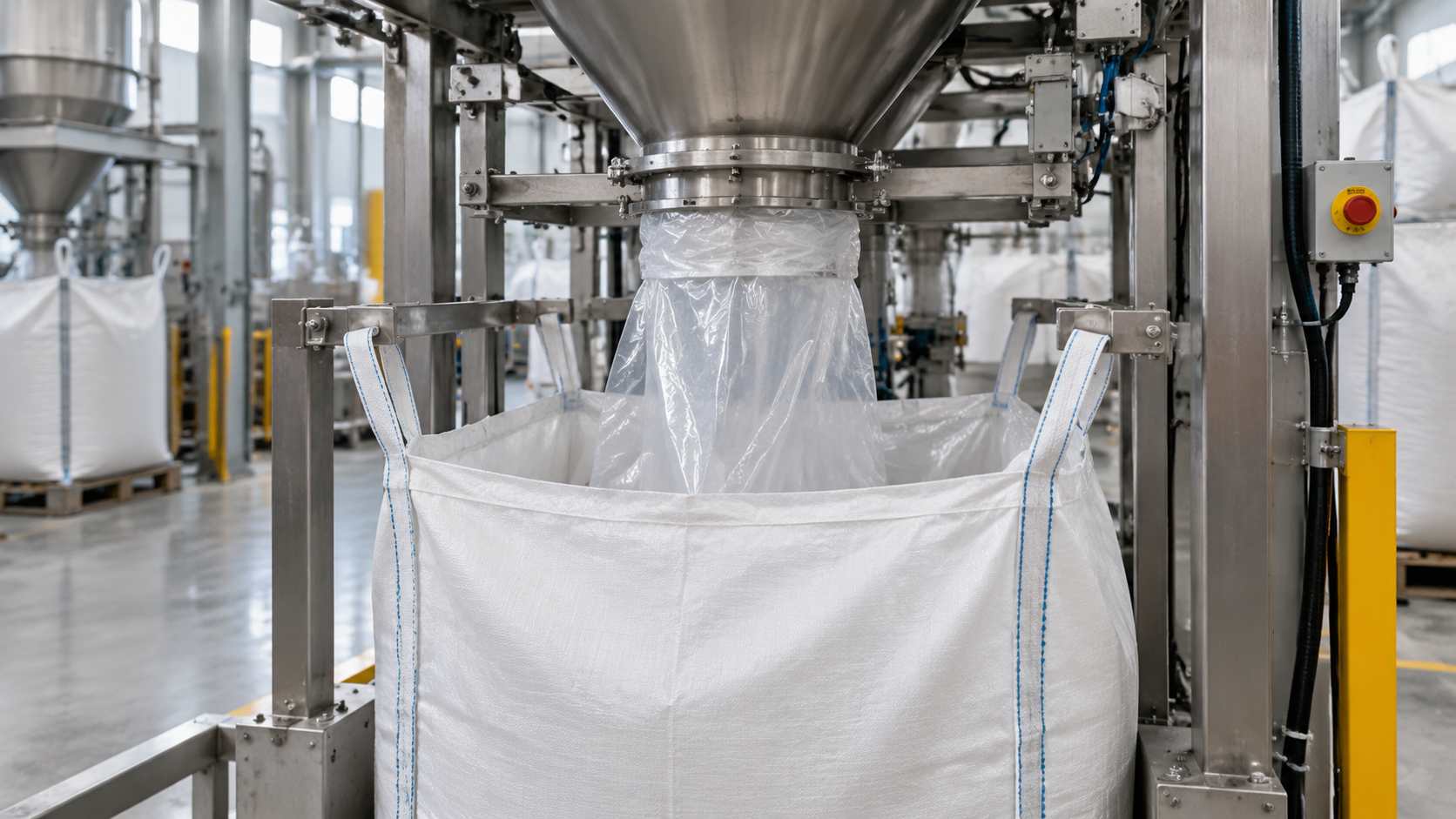
Liner geometry can affect line efficiency just as much as film selection. A loose tubular liner is relatively straightforward, but it may shift, wrinkle, or interfere with filling if it is not positioned correctly. A form-fit liner follows the shape of the FIBC more closely and can be designed around the filling and discharge openings.
When comparing options, check the following:
- Bag dimensions: Confirm the liner width, length, and shape against the actual internal dimensions of the filled FIBC.
- Filling spout: Ensure the liner opening fits the filling nozzle and can be secured without obstructing the process.
- Discharge outlet: Match the liner outlet to the bottom spout or discharge arrangement to limit trapped material.
- Attachment: Determine whether the liner should remain loose or be secured with tabs, ties, or another suitable method.
- Production speed: Test the design on the actual filling line rather than assuming that a manually fitted liner will work well with automated equipment.
For products with strict dust-control requirements, a sift-proof carbon black FIBC bulk bag may be worth evaluating as part of the complete containment system. Fine-powder performance depends on bag construction, seams, closures, and electrostatic requirements—not on the liner alone.
5. Practical Application: Exporting Hygroscopic Powder
Consider a hypothetical chemical producer shipping a moisture-sensitive powder in 1,000 kg FIBCs. The material can cake after moisture exposure, and the shipment travels by sea before being stored in a humid warehouse.
A basic liner specification based only on bag capacity would leave several important questions unanswered. The buyer should first establish the product's moisture sensitivity, expected storage duration, transport environment, and acceptable condition on arrival.
A practical evaluation could compare three configurations:
| Option |
Evaluation focus |
| Coated FIBC without a separate liner |
Whether the existing barrier is adequate for the product and shipping conditions. |
| FIBC with a PE liner |
Film integrity, closure performance, and moisture protection during transport. |
| FIBC with a high-barrier liner |
Whether the additional barrier is justified by the product's sensitivity and required shelf life. |
The supplier and buyer should compare samples under representative conditions, inspect the packages after transport simulation where appropriate, and measure product moisture or caking against agreed acceptance criteria. Without test results, it would be misleading to promise a specific reduction in product loss.
For applications requiring stronger protection, a aluminum foil laminate FIBC bulk bag is another option to assess when moisture, oxygen, light, or contamination requirements justify a multilayer construction.
6. A Specification Checklist for Bulk Buyers
To avoid repeated sampling and unclear quotations, provide the supplier with a complete technical brief. The following details help turn a general request for an FIBC liner into a specification that can be evaluated and tested.
- Product name, particle size, bulk density, and chemical compatibility requirements.
- Target filling weight and FIBC dimensions.
- Liner resin, nominal thickness, and required barrier properties.
- Required food-contact or other regulatory documentation, where applicable.
- Filling method, filling temperature, outlet design, and discharge equipment.
- Expected storage period, shipping route, humidity exposure, and stacking conditions.
- Static-control requirements for combustible or electrostatically sensitive materials.
- Sample testing criteria, inspection requirements, and acceptable product condition on arrival.
Dongbai's product range includes PE liners and films, specialty FIBCs, and integrated packaging solutions. The company reports ISO 9001 and ISO 14001 certifications and provides customized industrial packaging options. Buyers can use these details as a starting point for discussing material selection, product specifications, and quality documentation with the supplier.
Frequently Asked Questions
Does a thicker FIBC liner always provide better moisture protection?
No. Thickness is only one factor. Film composition, barrier layers, sealing quality, and exposure conditions also affect moisture performance. Compare test data under consistent conditions before choosing a thicker film.
What is the difference between a tubular liner and a form-fit liner?
A tubular liner has a relatively simple tube-shaped construction. A form-fit liner is designed to follow the shape of the FIBC more closely and can be configured around filling and discharge openings. The best choice depends on the equipment, handling method, and product flow.
Can an ordinary PE liner be used for combustible powders?
Not without evaluating the electrostatic risks. An ordinary insulating liner can affect the performance of the complete packaging system. The liner and FIBC must be specified together according to the material, process conditions, and applicable electrostatic safety requirements.
What information is needed to request a custom liner quotation?
Provide the product name, target filling weight, bag dimensions, moisture or contamination requirements, preferred film thickness if known, filling and discharge methods, and destination conditions. The supplier can then recommend a suitable configuration and confirm it through sample testing.
The most reliable FIBC liner specification is one that protects the product without creating avoidable problems on the filling line or during discharge. Define the actual risk, select the barrier and geometry accordingly, and validate the finished packaging under representative operating conditions before committing to bulk production.