In the FIBC (Flexible Intermediate Bulk Container) industry, SWL (Safe Working Load) and SF (Safety Factor) are two of the most important technical parameters used in product design, quality inspection, international purchasing, and bulk material handling operations.
However, many buyers, distributors, and even operators still confuse these two concepts. Some believe that a higher safety factor means the bag can carry more materials, while others only focus on loading capacity and ignore the safety rating behind the product.
This misunderstanding can lead to serious consequences, including lifting loop failure, bag rupture, material leakage, equipment damage, and workplace safety risks.
Understanding the difference between SWL and SF is essential for selecting the Right FIBC Bulk Bags, evaluating supplier quality, and ensuring safe transportation of bulk materials.
What Is SWL (Safe Working Load) of FIBC Bulk Bags?
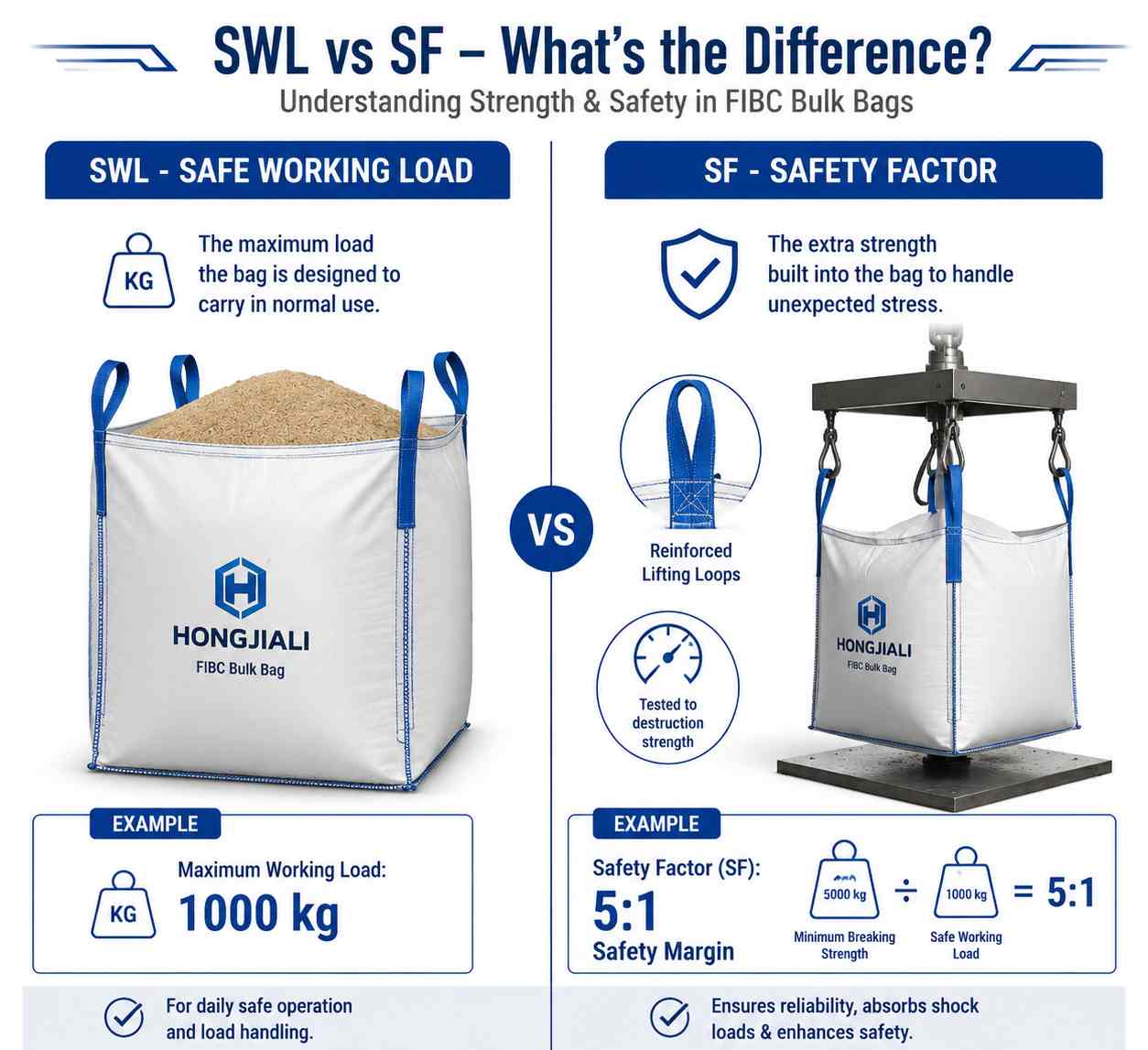
SWL stands for Safe Working Load, which refers to the maximum weight that an FIBC bag is designed and approved to carry under normal operating conditions.
In simple terms, SWL is the maximum loading limit of a bulk bag during daily use. It tells users:
- How much material the bag can safely contain;
- What weight limit should not be exceeded during filling and transportation;
- Which forklift, crane, or lifting equipment capacity is suitable.
Common FIBC load capacities include 500kg, 1000kg, 1500kg, and 2000kg. These numbers represent the SWL rating of the bulk bag.
| Common FIBC SWL Rating |
Typical Application |
Examples of Materials |
| 500kg |
Light-duty bulk handling |
Agricultural products, additives, lightweight powders |
| 1000kg |
Standard industrial bulk bag application |
Plastic resin, chemicals, minerals, construction materials |
| 1500kg |
Heavy-duty transportation |
Sand, aggregates, industrial powders |
| 2000kg+ |
Special reinforced FIBC designs |
High-density minerals and heavy industrial materials |
The SWL rating is determined based on multiple factors, including polypropylene fabric strength, lifting loop structure, stitching technology, bag dimensions, filling method, and safety requirements.
A bulk bag with a larger volume does not automatically have a higher SWL. The load capacity depends on the overall construction and reinforcement design.
Why Should FIBC Bags Never Exceed SWL?
SWL is not a recommended value but a strict operational limit. Even if an overloaded FIBC bag appears normal during filling, excessive weight creates additional stress on the lifting loops, seams, and fabric structure.
During transportation, the actual force applied to a bulk bag may increase due to:
- Forklift acceleration and braking;
- Sudden lifting impact;
- Uneven load distribution;
- Vibration during truck transportation;
- Repeated handling cycles.
These additional forces can gradually damage stitching areas and lifting components, increasing the possibility of unexpected failure.
What Is FIBC Safety Factor (SF)?
Safety Factor (SF), also called safety ratio, is a measurement used to evaluate the strength reserve of an FIBC bag compared with its rated working load.
Unlike SWL, which represents the maximum allowable loading weight, the safety factor does not have a weight unit. It is expressed as a ratio, such as 5:1, 6:1, or 8:1.
The basic calculation formula is:
| Safety Factor (SF) = Minimum Breaking Load ÷ Safe Working Load |
For example, if a bulk bag has a Safe Working Load of 1000kg and a safety factor of 5:1, the lifting structure must withstand a minimum breaking load of at least 5000kg during testing.
This does not mean the bag can carry 5000kg in actual use. The 5000kg value represents the tested breaking strength, while 1000kg remains the maximum operating load.
| Parameter |
Meaning |
Used By |
| SWL (Safe Working Load) |
Maximum weight the FIBC can safely carry during normal operation |
Operators, warehouse teams, logistics staff |
| SF (Safety Factor) |
Strength margin between working load and breaking strength |
Engineers, manufacturers, quality inspectors, buyers |
| Minimum Breaking Load (MBL) |
The minimum force required to cause failure during testing |
Laboratory testing and certification |
Common FIBC Safety Factor Standards: 5:1, 6:1, and 8:1
Different applications require different safety levels. The selection of safety factor depends on material characteristics, transportation conditions, reuse requirements, and Specialty FIBC Bulk Bags.
| Safety Factor |
Typical Application |
Features |
| 5:1 |
Single-trip FIBC bags |
Standard industrial use, cost-effective solution for normal handling conditions |
| 6:1 |
Multi-trip or export FIBC bags |
Higher strength design for repeated handling and longer transportation cycles |
| 8:1 |
Special-duty and high-risk applications |
Maximum strength reserve for demanding environments and frequent lifting |
For international buyers sourcing FIBC Bulk Bags, selecting the correct safety factor is especially important because transportation conditions may involve longer storage periods, multiple handling operations, and different lifting equipment.
SWL vs SF: What Is the Real Difference?
The biggest misunderstanding in the bulk bag industry is treating SWL and SF as the same parameter. In reality, they answer two completely different questions:
| Question |
Relevant Parameter |
Example |
| How much material can this bag carry? |
SWL |
1000kg bulk bag = maximum 1000kg filling weight |
| How much strength reserve does the bag have? |
SF |
5:1 means tested breaking strength is 5 times the SWL |
For example, two FIBC bags may both have a SWL rating of 1000kg. One may have a 5:1 safety factor, while another may have a 6:1 or 8:1 safety factor.
Their loading capacity is the same, but their resistance against impact, repeated handling, and unexpected stress conditions is different.
How to Choose the Right SWL and Safety Factor When Purchasing FIBC Bags?
For international buyers, selecting suitable FIBC Bulk Bags requires more than simply choosing a weight capacity.
The correct combination of Safe Working Load of FIBC Bags and safety factor should match the material characteristics, transportation method, and final application environment.
| Application Requirement |
Recommended Consideration |
| Standard one-time transportation |
1000kg SWL with 5:1 safety factor is commonly selected |
| Long-distance export shipping |
Consider 6:1 safety factor for additional handling reliability |
| Repeated lifting cycles |
Choose higher strength construction and suitable multi-trip design |
| Heavy industrial materials |
Use reinforced loops, stronger fabric, and higher safety factor options |
When communicating with FIBC suppliers, buyers should confirm the following information before placing orders:
- Rated SWL capacity;
- Safety factor requirement;
- Lifting loop structure;
- Fabric weight and material specification;
- Stitching method and reinforcement design;
- Applicable handling equipment;
- Testing reports or quality inspection records.
FIBC Quality Inspection Checklist for SWL and Safety Factor
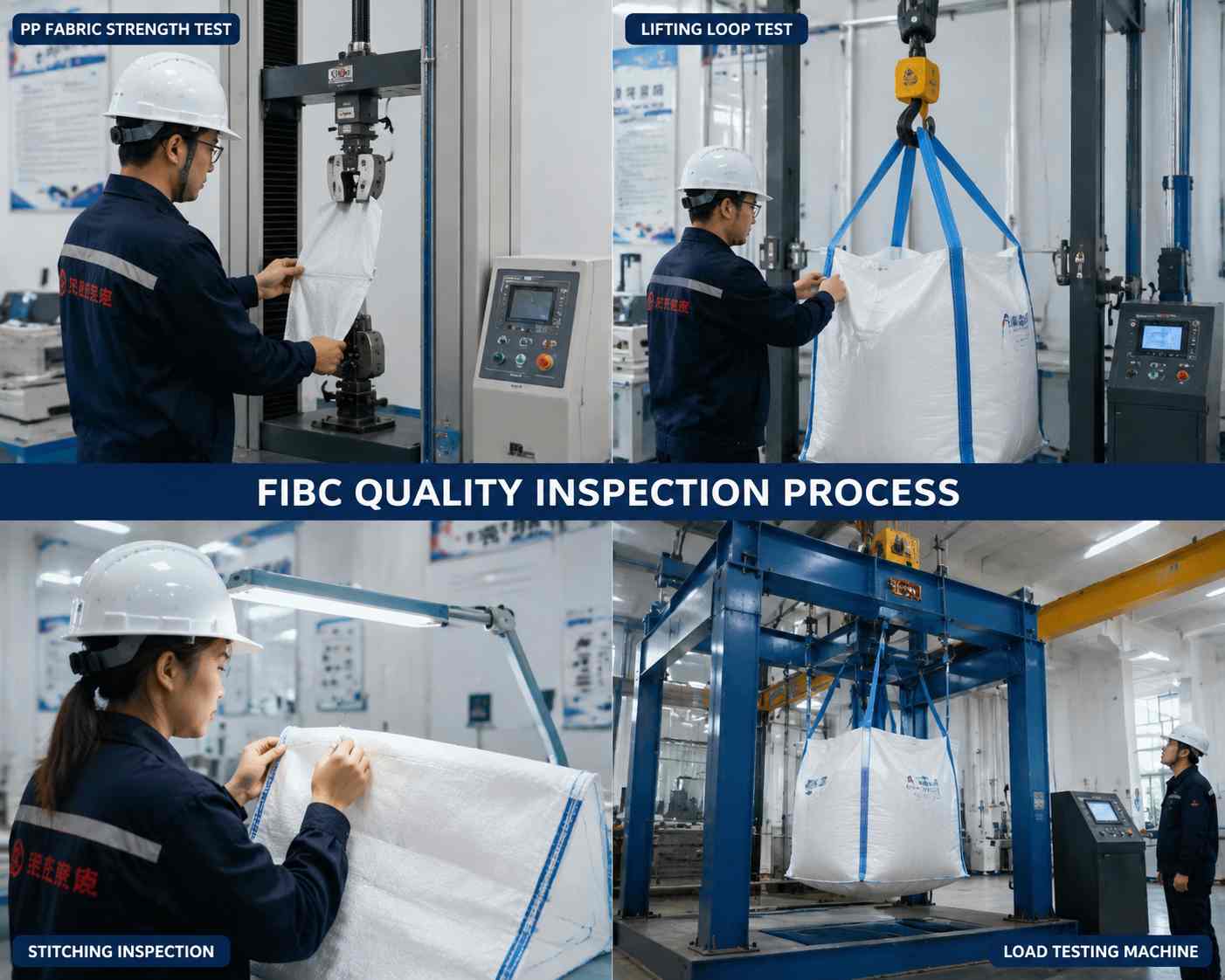
A professional FIBC manufacturer should control not only the final product appearance but also the structural strength related to lifting safety.
| Inspection Item |
Purpose |
| Fabric Tensile Strength Test |
Ensures polypropylene fabric can withstand the designed working load |
| Lifting Loop Strength Test |
Verifies loop performance under lifting conditions |
| Seam Strength Inspection |
Prevents stitching failure during loading and transportation |
| Load Test |
Confirms the bulk bag meets required safety factor standards |
| Visual Inspection |
Identifies defects such as damaged loops, weak seams, or fabric defects |
Common Mistakes When Evaluating FIBC Load Capacity
Many purchasing mistakes happen because buyers focus only on the loading weight and ignore the complete safety design.
| Common Mistake |
Correct Understanding |
| "Higher SF means the bag can hold more material" |
SF improves strength reserve, but SWL determines loading weight |
| "All 1000kg FIBC bags have the same strength" |
Different designs may have different safety factors and durability |
| "Large bag size means higher capacity" |
Capacity depends on construction, material strength, and design |
| "Visual appearance determines quality" |
Structural testing is necessary to verify lifting safety |
SWL Defines Capacity, SF Defines Safety Margin
For anyone purchasing or using FIBC Bulk Bags, understanding the relationship between SWL and safety factor is essential.
SWL determines how much material the bag can safely carry, while FIBC Safety Factor determines how much strength reserve the bag has against unexpected stress during handling.
The combination of a suitable Safe Working Load of FIBC Bags, proper safety factor selection, reliable materials, and professional manufacturing processes ensures safer lifting, better transportation efficiency, and more stable supply chain performance.
For industrial users, distributors, and international buyers, selecting the right FIBC specification is not only about capacity — it is about matching the correct safety level with the actual application.
Frequently Asked Questions About SWL and FIBC Safety Factor
1. Does a 6:1 safety factor FIBC bag carry more weight than a 5:1 bag?
No. The loading capacity depends on SWL, not safety factor. A 1000kg SWL FIBC with 5:1, 6:1, or 8:1 safety factor can all carry 1000kg under approved conditions. The difference is the additional strength margin and durability.
2. What does 5:1 safety factor mean for FIBC Bulk Bags?
A 5:1 safety factor means the bag's minimum breaking strength must reach five times its Safe Working Load. For example, a 1000kg SWL bag requires a minimum breaking load of approximately 5000kg during testing.
3. How do I know the Safe Working Load of FIBC Bags?
The SWL is normally marked on the FIBC label or product specification sheet provided by the manufacturer. Buyers should always confirm the rated load before filling, lifting, or transporting bulk bags.
4. Which safety factor should I choose for export FIBC orders?
For export applications involving long-distance transportation, multiple handling operations, or strict customer requirements, higher safety factor options such as 6:1 may provide additional reliability.