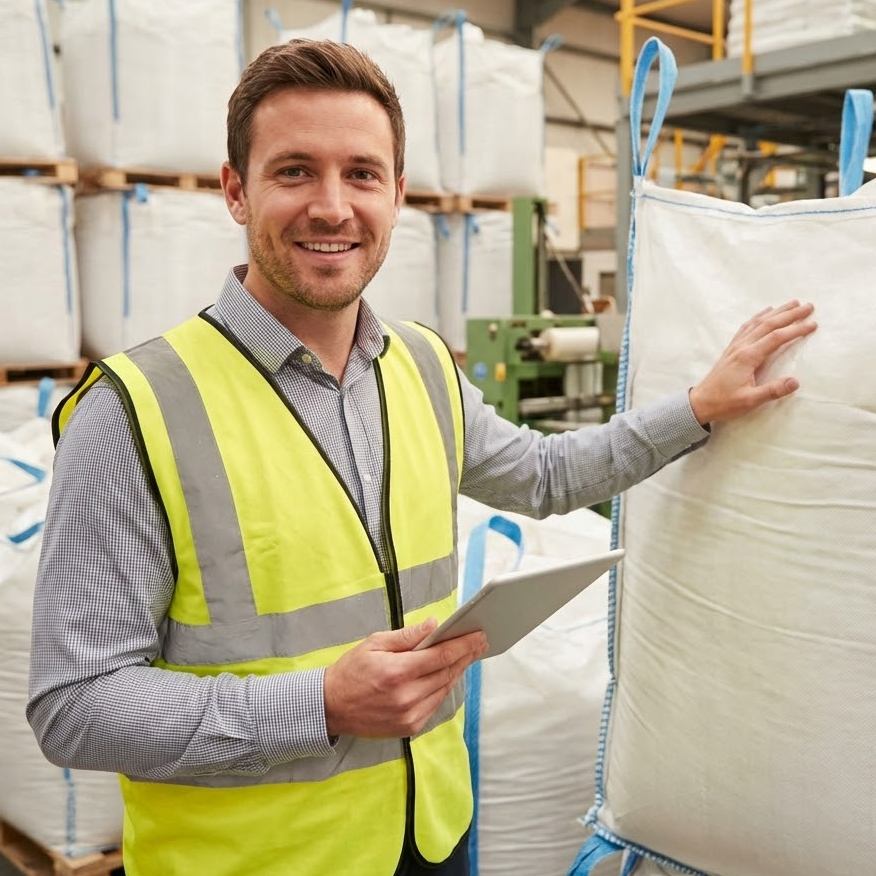
In industries such as plastics, chemicals, mining, construction materials, agriculture, and food processing, forklifts are widely used for transporting bulk bags in warehouses, factories, and distribution centers.
FIBC (Flexible Intermediate Bulk Container) bags are designed for efficient storage and transportation of dry bulk materials. However, because a fully loaded bulk bag may weigh hundreds or even thousands of kilograms, proper lifting methods are essential to ensure workplace safety.
During daily operations, some workers directly insert forklift forks into the lifting loops of bulk bags for lifting and transportation. Although this method is commonly seen in many facilities, improper handling can cause lifting loop failure, material leakage, equipment damage, and serious safety hazards.
So, can a forklift directly hook and lift a bulk bag by its lifting loops?
The answer is: Yes, but only when the bulk bag design, lifting structure, load condition, and operating method meet safety requirements. Direct forklift lifting should never be considered a universal handling method.
A properly manufactured FIBC with reinforced lifting loops can support forklift handling, but operators must understand the bag construction, safe working load (SWL), and correct lifting procedure before transportation.
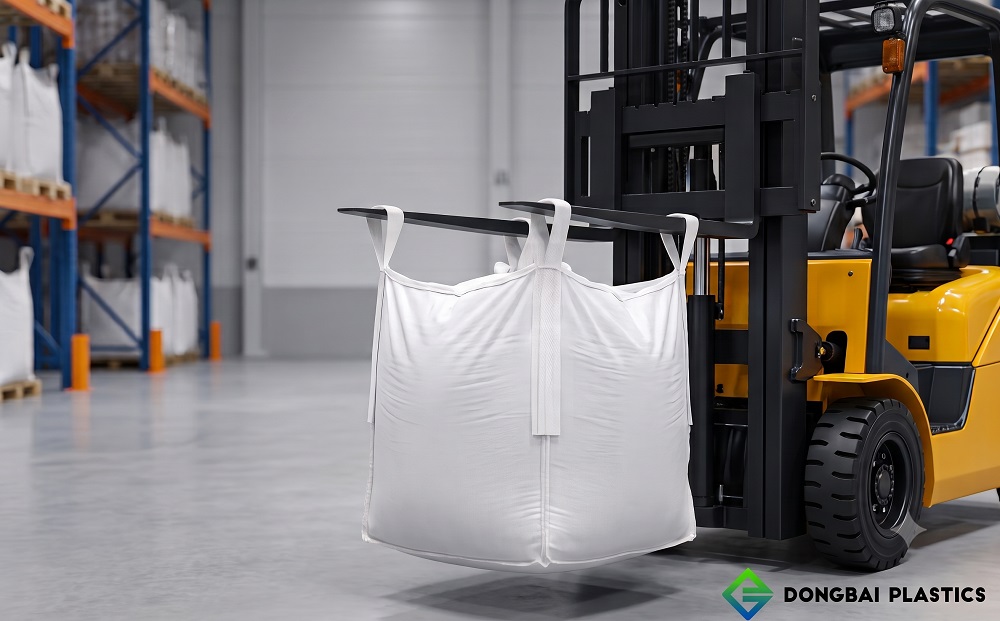
When Is Forklift Lifting Through Bulk Bag Loops Allowed?
The key requirement for direct forklift lifting is that the FIBC bag must have a suitable lifting structure and remain in safe working condition.
Only properly designed Standard Four-loop Bulk Bags with reinforced lifting points are generally suitable for this handling method.
For example, properly manufactured Bulk Bags with Four Lifting Loops are designed with a balanced four-point lifting structure, allowing the load to be distributed more evenly during lifting.
The lifting capacity of an FIBC depends on multiple factors, including fabric strength, lifting loop construction, stitching quality, bag design, and safety factor.
| Factor |
Impact on Lifting Safety |
| Lifting Loop Design |
Determines how the lifting force is transferred from the forklift to the bag body. Reinforced loops reduce stress concentration. |
| Stitching Strength |
High-quality stitching helps prevent loop separation or tearing under heavy loads. |
| Safe Working Load (SWL) |
The maximum recommended load capacity that the bulk bag can safely handle during normal operation. |
| Safety Factor |
Provides additional strength margin between the working load and the bag's breaking strength. |
However, direct forklift lifting is strictly prohibited for the following conditions:
| Condition |
Why It Is Unsafe |
| Single-loop or two-loop bulk bags |
The lifting force cannot be evenly distributed, increasing the possibility of loop failure. |
| Damaged, worn, or repaired lifting loops |
Previous damage may significantly reduce the original load-bearing capacity. |
| Bags exposed to moisture, UV radiation, or long-term outdoor storage |
Polypropylene fabric and lifting components may experience aging and strength reduction. |
| Visible stitching damage or weakened lifting points |
The lifting structure may fail even if the bag body appears normal. |
Before lifting, operators should inspect the entire bulk bag structure, including lifting loops, seams, fabric condition, and filling condition.
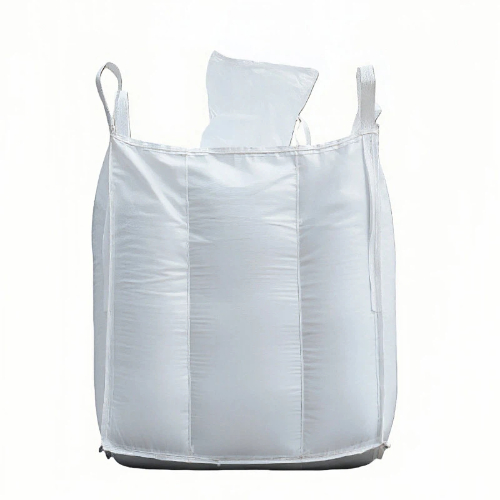
Correct Forklift Lifting Method for Bulk Bags
When direct forklift lifting is allowed, correct operation is critical to maintaining load stability and preventing damage to the lifting loops.
The forklift forks should pass through the lifting loops correctly to create balanced support. The load should remain centered, stable, and vertically aligned during lifting.
| Correct Practice |
Incorrect Practice |
| Forks fully inserted through opposite lifting loops |
Partial contact with only one side of the loops |
| Balanced four-point lifting |
Single-loop or single-fork lifting |
| Slow and controlled lifting speed |
Sudden acceleration or impact loading |
| Smooth forklift forks without sharp edges |
Damaged forks cutting into lifting loops |
In addition, the contents inside the bulk bag must be evenly distributed. Overloading, uneven filling, or an unstable center of gravity can create excessive tension on individual lifting loops and increase the possibility of structural failure.
Operators should also understand that the actual force applied to lifting loops during transportation is not always equal to the static weight of the material.
During forklift operation, sudden acceleration, braking, turning, or dropping movements can generate additional dynamic forces. These impact forces may temporarily increase the load on individual lifting loops beyond the normal working load.
Potential Risks of Direct Forklift Loop Lifting
Although direct forklift lifting through loops provides a fast and convenient handling method, it also has certain limitations when used incorrectly.
The main safety concern is uneven load distribution. When a forklift moves, the center of gravity of the bulk bag may shift, causing one lifting loop or one side of the bag to carry more stress than the others.
| Risk Factor |
Possible Consequence |
Recommended Prevention |
| Uneven material filling |
Unbalanced load and excessive stress on individual lifting loops |
Ensure materials are evenly filled before transportation |
| Overloading beyond SWL |
Fabric deformation, stitching failure, or loop tearing |
Follow manufacturer-rated safe working load requirements |
| Sudden forklift movement |
Additional impact force on lifting components |
Operate forklift smoothly with controlled speed |
| Damaged lifting loops |
Unexpected lifting point failure |
Inspect loops before every lifting operation |
This risk becomes more significant when handling heavy materials such as minerals, chemical powders, plastic resin, agricultural products, and construction materials. A falling bulk bag may result in:
- Material loss and contamination;
- Damage to forklifts, storage equipment, or production facilities;
- Worker injury caused by falling loads;
- Production delays and additional handling costs.
Therefore, companies should strictly prohibit unsafe bulk bag handling practices, including:
- Lifting a bulk bag with only one fork or one lifting loop;
- Dragging filled bulk bags directly on the ground;
- Transporting suspended bags at excessive heights;
- Allowing workers to stand or walk underneath suspended loads.
Bulk bags exposed to prolonged sunlight, rain, moisture, chemicals, or outdoor storage conditions should receive additional inspection because environmental factors may reduce polypropylene fabric strength over time.
When Should a Lifting Frame Be Used?
For frequent transportation, heavy-duty applications, or long-distance warehouse movement, using a professional lifting frame is strongly recommended.
Unlike direct forklift lifting through loops, a lifting frame supports all lifting points simultaneously and helps distribute the load more evenly across the entire FIBC structure.
| Application Situation |
Recommended Handling Method |
| Occasional movement of standard FIBC bags |
Forklift lifting through suitable reinforced loops may be acceptable |
| Daily warehouse transportation |
Consider using lifting frames to improve consistency and safety |
| Heavy materials or high-capacity bulk bags |
Professional lifting equipment is strongly recommended |
| Strict safety-controlled industries such as chemicals and food processing |
Use standardized lifting systems according to operational requirements |
A dedicated lifting device can help prevent:
- Localized stress concentration;
- Lifting loop twisting and deformation;
- Damage caused by improper fork contact;
- Unstable load conditions during transportation.
Many professional factories, international warehouses, and standardized industrial facilities use lifting frames as part of their regular bulk bag handling procedures.
For companies requiring different lifting structures, capacities, and handling solutions, choosing Reliable FIBC Bags with Suitable Designs can significantly improve operational safety and efficiency.

Establishing Safe Bulk Bag Handling Practices
Workplace safety depends not only on product quality but also on standardized operating procedures.
Companies should establish a complete bulk bag handling system, including operator training, equipment inspection, and lifting procedures.
| Inspection Item |
Check Requirement |
| Lifting Loops |
Check for cuts, abrasion, stretching, or stitching damage |
| Bag Body |
Confirm no holes, severe deformation, or material leakage |
| Forklift Equipment |
Ensure forks are smooth and free from sharp edges |
| Loading Condition |
Verify filling level and load distribution are acceptable |
| Operating Environment |
Keep lifting areas clear and prevent personnel from entering danger zones |